Projects
A selection of my most impactful projects, from research prototypes to community infrastructure.
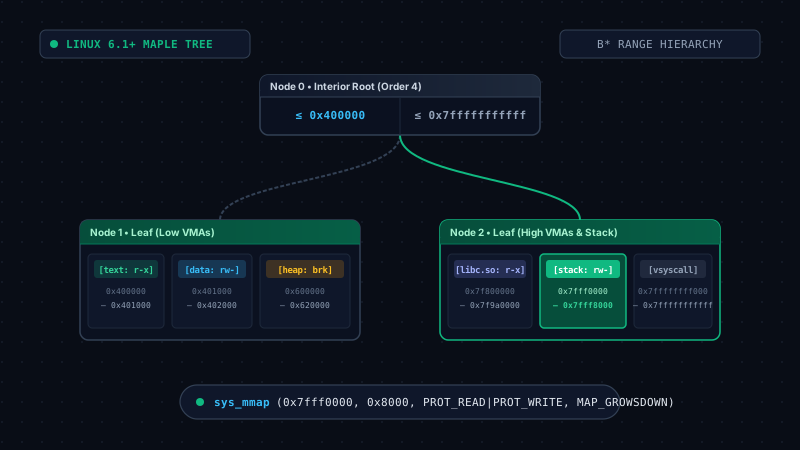
An interactive systems visualizer for the Linux 6.1+ kernel Maple Tree data structure and virtual memory subsystem.
Linux Maple Tree Visualizer
My Role
I designed and built the visualizer; implementing the range-based B-tree logic in TypeScript, building the interactive D3.js canvas, and creating step-by-step walkthroughs to make kernel memory management concepts easier to explore.
Key Features
- Simulates Linux 6.1+ kernel VMA management (lib/maple_tree.c, mm/mmap.c) with B* sibling balancing, cascading RCU splits, and hole-punching.
- Features 12 interactive scenarios demonstrating demand paging, ASLR 48-bit address sparsity, W^X JIT lifecycles, and CVE-2017-1000364 Stack Clash protection.
- Hardware-accelerated D3.js SVG canvas with continuous auto-centering, dynamic 48-bit node sizing, time-travel scrubbing, and real-time kernel telemetry.
Tech Stack
Impact & Significance
A visual, interactive learning tool to help developers, students, and systems enthusiasts better understand how the modern Linux kernel organizes process memory, resolves page faults, and manages address spaces under the hood.

A query-driven knowledge graph and OSINT automation engine.
Claros
My Role
As Project Owner and Lead Developer, I built this tool from concept to deployment for my senior design project, based on my previously published research at the International Conference on Cyber Warfare & Security (ICCWS) conference.
Key Features
- Parses NMap scans to automatically discover related domains, vulnerabilities, and exploits.
- Constructs a semantic knowledge graph to reveal complex relationships between entities.
- Allows analysts to query the graph with SPARQL to accelerate the reconnaissance phase.
Tech Stack
Impact & Significance
Claros transforms the manual process of OSINT into an automated workflow. It empowers security analysts to prioritize targets and uncover attack paths with an efficiency comparable to enterprise tools like Bloodhound.

A high-performance, kernel-level data collection utility for cloud-native environments.
sysmonitor-ebpf
My Role
As a key research contributor, I co-designed the monitor, developed the kernel-level network logging module using C and eBPF, and orchestrated the vulnerable cloud-native environments for testing and validation.
Key Features
- Deploys at the hypervisor level, providing namespace-aware monitoring without per-container configuration.
- Uses eBPF and ring buffers for highly efficient, low-overhead data collection at the kernel level.
- Provides holistic visibility into both system calls and network events for robust threat detection.
Tech Stack
Impact & Significance
This work, published at the prestigious ACM AICCC conference, presents a more efficient alternative to traditional sidecar monitoring and serves as the foundation for modern cloud-native security tools.

A custom, sandboxed lab environment for hands-on cybersecurity education.
Cybersecurity Training Lab
My Role
As President of Drexel Cyberdragons, I designed and led the implementation of this critical infrastructure, including all network configuration, VLAN segmentation, and Proxmox-based virtual machine orchestration on recycled enterprise servers.
Key Features
- Features VLAN-segmented networks to isolate vulnerable machines from attacker VMs and the campus network.
- Provides on-demand Kali Linux instances, removing hardware constraints for students and faculty.
- Accessible via a dedicated local Wi-Fi network for easy, VPN-free access during workshops.
Tech Stack
Impact & Significance
This lab provided a secure, sandboxed environment that enabled 500+ students to safely practice and develop advanced skills in penetration testing, incident response, and systems administration.